City Buildings vs. Hill Villas: The Real Summer Temperature Gap
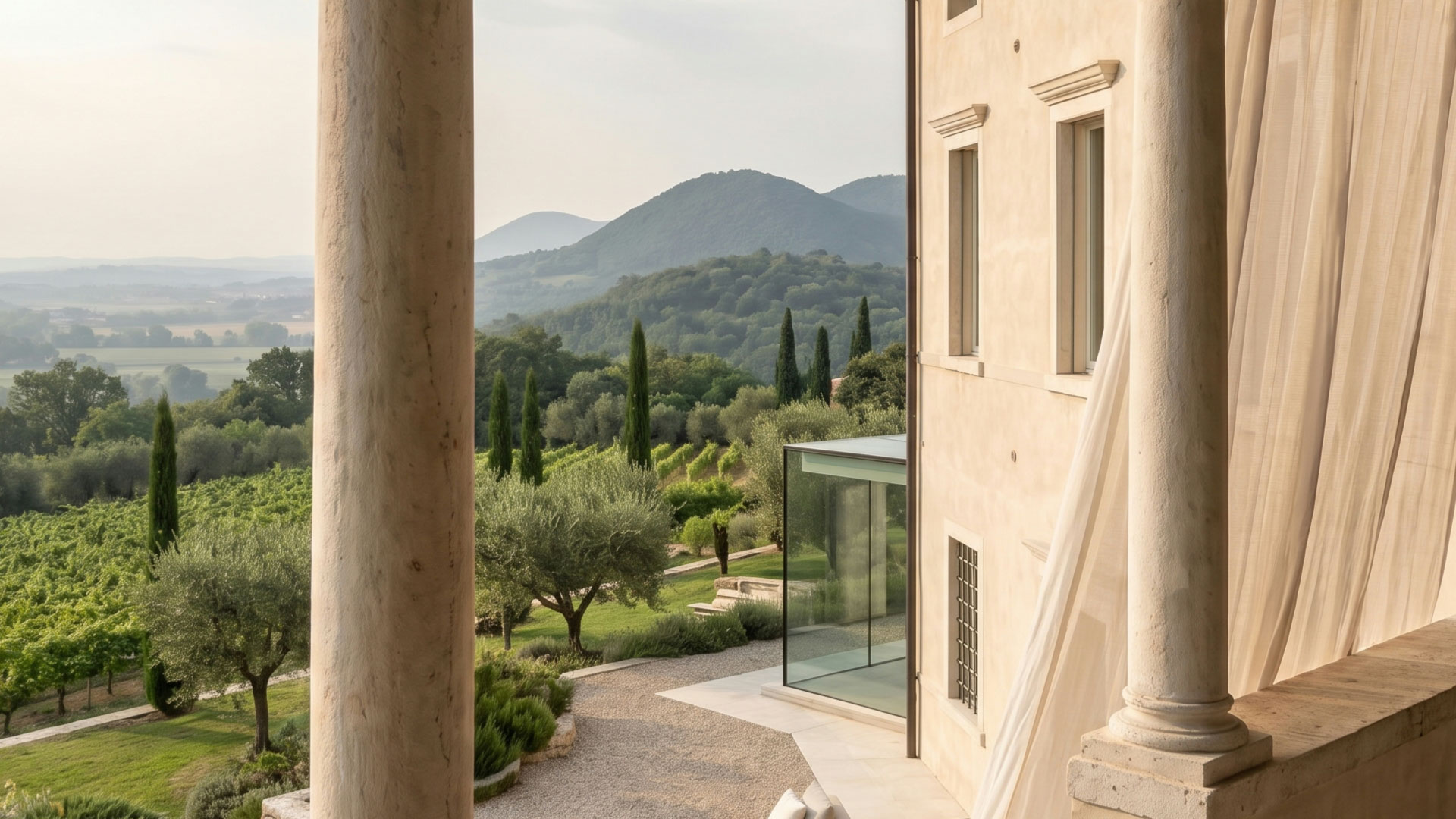
Ask anyone who splits their summer between a city apartment and a hillside villa which one is more bearable in August, and the answer is never in doubt. That difference isn't just charm or nostalgia — it's two separate physical effects stacking on top of each other: the urban heat island pushing city temperatures up, and elevation plus greenery pulling hillside temperatures down. European research quantifies both sides of this gap in detail.
Why city buildings run hot
Dense, low-elevation urban cores are the hottest points in any European region during summer.
- City surface temperatures can run 10–15°C higher than neighboring rural areas, according to the European Commission's Joint Research Centre. [1]
- The EU's Copernicus-based UrbClim model has mapped hourly urban heat island intensity at 100-metre resolution across 100 European cities (2008–2017); EEA analysis shows a meaningful share of schools and healthcare facilities sit inside zones where the heat effect exceeds 2°C above the regional average. [2]
- A Nature Communications study of 293 European cities found continuous built-up urban fabric runs measurably hotter than any vegetated patch nearby. [3]
- An EU-funded project (iSCAPE, led by the University of Surrey), modeling the town of Guildford, found trees consistently the most effective green infrastructure type at reducing urban heat. [4]
The mechanism is structural and consistent across Europe: dark, dense surfaces absorb and re-radiate heat, tall buildings trap warm air at street level and block airflow, and there's little vegetation left to cool the air through evapotranspiration.
Why hill villas run cooler
A villa on a hillside benefits from two compounding effects that a city apartment simply doesn't have access to.
1. Elevation
Air temperature drops with altitude at a well-documented rate across European mountain ranges. A study across the Italian Alps, Tyrol, and Trentino–Alto Adige, using 269 climate stations in northern Italy alone, found a yearly lapse rate of 5.4–5.8°C per 1,000 metres, with steeper rates in summer. [6]
A six-year dataset from the Val Mazia valley in the Italian Alps confirms seasonal lapse rates of 4.7°C to 6.7°C per 1,000 metres. Even a modest gain of 200–400 metres, typical of many European hill towns, produces measurable baseline cooling before any architecture or landscaping comes into play. Research on Alpine heritage buildings in Valtellina and Valposchiavo confirms this elevation effect shapes indoor microclimates directly. [7,8]
2. Vegetation and open land
Hillside properties are typically surrounded by vineyards, woodland, or open countryside rather than paved surfaces, and European data shows this cools measurably:
- The 293-city study found urban trees 0–4°C cooler than built-up areas in Southern Europe, and 8–12°C cooler in Central Europe, during summer and heat extremes. [3]
- A European-scale study found land surface temperature reductions translate to roughly half that reduction in air temperature at 2 metres, with an estimated 23.5% aggregate residential cooling-energy saving if roofs across Europe were greened. [5]
- A vegetated hillside replicates this same mechanism at landscape scale: continuous canopy and open land extend, across an entire hillside estate, the cooling effect measured on individual green roofs and street trees. [3,5]
A local example: the Euganean Hills
Just south of Padua, the Colli Euganei rise 300–600 metres out of the flat Padovan plain — a landscape long favored by Venetian and Paduan nobility for exactly this reason, with historic villas like Villa Barbarigo and Villa Duodo built into the hillsides among vineyards and woodland. The volcanic hills create their own microclimate: forested slopes and elevation combine to keep hillside villages measurably more comfortable in summer than the plain below. [10]
What this means for design and value
The gap between a city building and a hill villa isn't just about location — it's a combination of physics (elevation), ecology (vegetation), and architecture. Traditional Mediterranean villa design compounds the advantage further.
Field studies of historic courtyard housing in Seville, Andalusia — a traditional building typology found across Mediterranean cities — confirm that courtyards measurably improve thermal comfort in the hot season, moderating extremes that reach the surrounding street. [9]
- South-facing terraces with deep loggias capture winter sun while shading summer heat.
- Thick stone walls, typical of Alpine and Mediterranean vernacular building alike, provide the thermal mass that traditional construction relied on before mechanical cooling existed.
- Enclosed courtyards and covered porticoes, common to both historic Veneto villas and Mediterranean courtyard housing, create shaded outdoor microclimates that a city balcony can't replicate.
- Cross-ventilation from surrounding open land works far more effectively where there's no dense urban canyon blocking airflow.
For real estate — especially heritage and luxury villa properties — this stacks two independent, physically grounded advantages (elevation and greenery) on top of good passive design. It's a genuine differentiator that a city apartment, however well-designed, cannot fully replicate: no amount of architecture fixes the fact that it's sitting in the hottest, lowest, most built-up part of the region.
Sources
- European Commission Joint Research Centre — Cities are often 10-15°C hotter than their rural surroundings
- European Environment Agency (EEA) / Copernicus Climate Change Service (C3S) — UrbClim model, urban heat island across 100 European cities
- Schwaab, J. et al. (2021), Nature Communications — The role of urban trees in reducing land surface temperatures in European cities (293 cities)
- CORDIS / European Commission — More trees, cooler cities (EU-funded iSCAPE project, University of Surrey, Guildford case study)
- Manoli, G. et al., Scientific Reports (2021) — Water, energy and climate benefits of urban greening throughout Europe under different climatic scenarios
- Rolland, C. (2003), Journal of Climate — Spatial and Seasonal Variations of Air Temperature Lapse Rates in Alpine Regions (northern Italy, Tyrol, Trentino–Alto Adige)
- Scientific Data / PMC (2024) — Six years of high-resolution climatic data collected along an elevation gradient in the Italian Alps (Val Mazia – Matschertal)
- MDPI (2025) — Heritage at Altitude: Navigating Moisture Challenges in Alpine Architectural Conservation (Valtellina, Valposchiavo)
- ScienceDirect — Seasonal analysis of thermal comfort in Mediterranean social courtyards (Seville, Andalusia)
- Wikipedia / Parco Regionale dei Colli Euganei — geography, elevation, and historic villas near Padua
More news
View all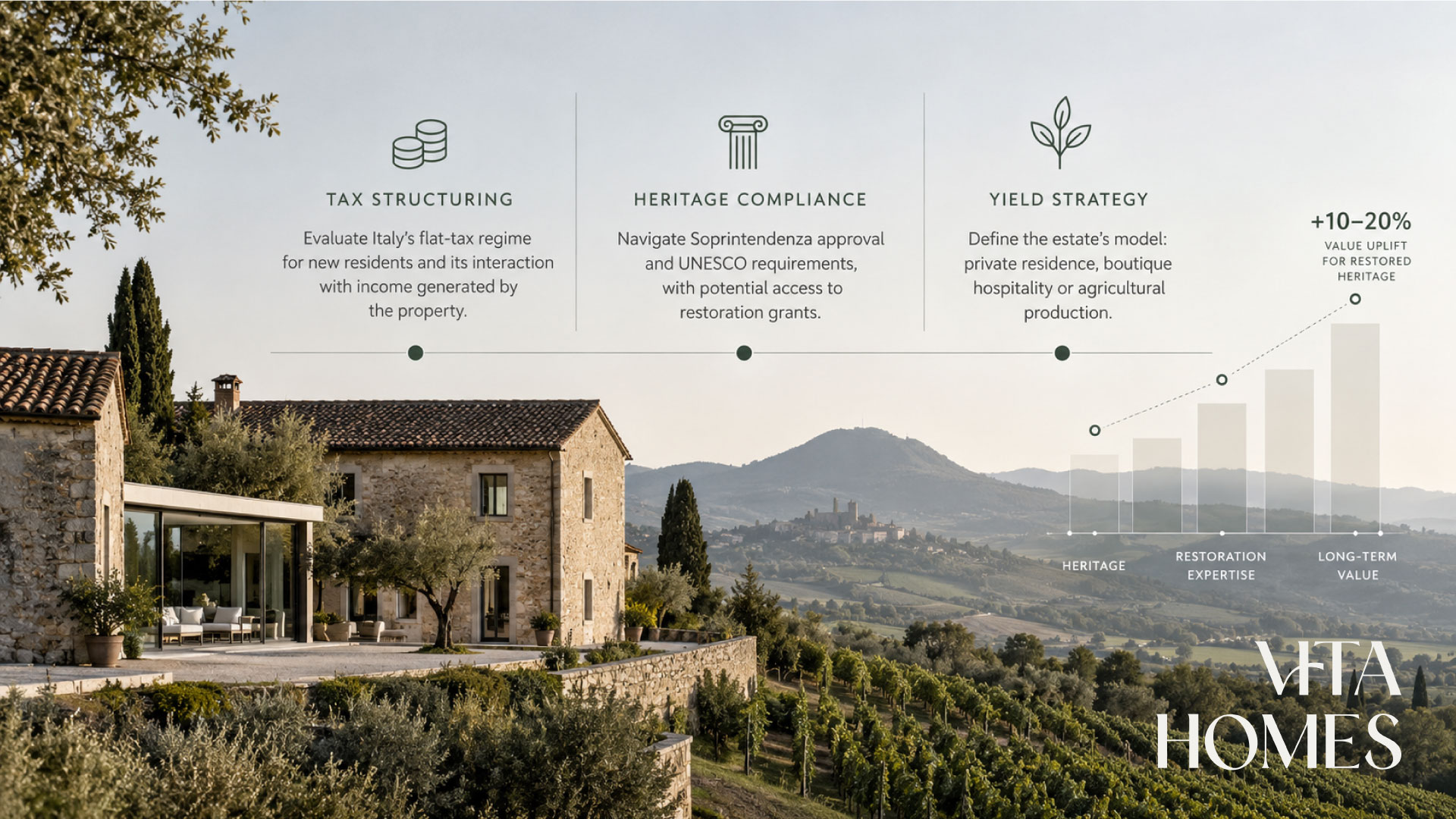
Heritage as a Working Asset: Restoring Historic Italian Estates in 2026
The most significant shift in Italian heritage property in 2026 is not about price — it is about purpose. Historic estates are no longer bought purely as private retreats. Increasingly, restoration is framed as an entrepreneurial strategy as much as an aesthetic one, and that changes everything about how these properties are chosen, restored and owned.
contact us
.avif)