Prime European Property in 2026: Buyer Shifts, Currency and Luxury Trends

Europe's primeresidential markets are being reshaped by three forces at once: a changing mixof international buyers, the quiet but powerful influence of currency, and anevolution in what wealthy purchasers actually want from a home. Drawing onKnight Frank's July 2026 European research and Sotheby's International Realty'sluxury outlook, here is how the picture looks.
A shift in who is buying
According to KnightFrank agents across more than twenty prime European markets, the composition ofoverseas demand is rebalancing toward Western buyers. Buyers from Europe(excluding the UK) remain the largest group but eased from around 45% ofweighted overseas demand in the second half of 2025 to just under 40% in thefirst half of 2026, as UK and US buyers strengthened. UK buyers alone accountedfor roughly a third of overseas demand in the first half of 2026, expandinginto Madrid, Ibiza and Tuscany while holding leading positions in Monaco andthe French Riviera. US buyers, meanwhile, are broadening their footprint acrosslifestyle and urban destinations — with Milan, Ibiza and the Algarve among themarkets where they are gaining ground.
Currency: the hiddendriver of value
Exchange-rate movementsremain a critical, and often underestimated, driver of cross-border demand. Asof mid-2026 Knight Frank notes that sterling retained a relative advantage,with £1 buying around €1.15, while the dollar was weaker against the euro atroughly $1 to €0.87. A stronger pound enhances UK buyers' purchasing poweracross euro-denominated markets, helping sustain demand for lifestyledestinations such as the Algarve, Marbella and the Balearics, while softerdollar conditions have marginally trimmed US purchasing power from recent peaks— even as US demand stays robust on the back of strong wealth creation.
Price growth looksdifferent in every currency
One of Knight Frank'smost useful observations is that headline price growth can mislead oncecurrency is taken into account. Taking Milan as an example, prices rose around36% for a euro-based buyer over the 2020–2025 period, but the effectiveincrease was closer to 32% for UK buyers, 31% for US buyers and just 17% forSwiss buyers, once exchange-rate shifts are factored in. The same pattern holdsin Madrid, Lisbon and Paris: the return an international buyer actuallyexperiences depends heavily on the currency they hold.
The 2026–2027 outlook
Looking ahead, OxfordEconomics forecasts (cited by Knight Frank) point to continued upward pressureon European residential prices. Mainstream house prices in Portugal and Spainare projected to rise by 10–11% this year before easing to 3% and 5% respectivelyby 2027, with more modest single-digit growth elsewhere. France and Germany areexpected to pick up slightly next year, from around 1–2% this year toward 4–5%.
What HNWIs are looking fornow
Beyond geography andcurrency, Sotheby's International Realty identifies a clear evolution in buyerpriorities across prime markets:
Multigenerational living
Close to one in five USluxury purchases now involves buyers planning to live with extended family,reshaping design toward guesthouses, self-contained apartments and multipleprimary suites.
Longevity and wellness
Aging-in-place featuresare becoming standard in the highest tier of homes, alongside private wellnessspaces, air and water filtration and biophilic design that connects interiorsto the landscape.
Discretion over display
Buyers increasinglyfavour gated, low-density, privacy-oriented properties over visiblyostentatious ones — part of why branded and heritage residences, which pairdiscretion with trust and resale liquidity, are gaining ground.
Scarcity-driven value
Waterfront, park-facingand architecturally distinctive properties command premiums precisely becausethey cannot be replicated. It is a preference that maps almost perfectly ontoItaly's protected heritage landscapes.
Where this leaves thediscerning buyer
Taken together, thesignals favour markets that combine lifestyle, stability and genuine scarcity —and Italy sits at that intersection. Milan's strength as an urban centre andthe enduring pull of the central-Italian countryside give buyers both the connectivityand the authenticity the 2026 market is rewarding.
Discover what VitaHomes isbuilding next
The philosophy behindevery VitaHomes residence is the faithful restoration of Italy's builtheritage, paired with contemporary living and a complete ecosystem of servicesthat makes ownership effortless. Explore our upcoming projects and see howheritage becomes home.
Sources &disclaimer. Market data drawn from Knight Frank's European ResidentialSignals (July 2026), Oxford Economics forecasts as cited therein, and Sotheby'sInternational Realty's 2026 luxury outlook. Provided for general informationonly; not investment advice.
More news
View all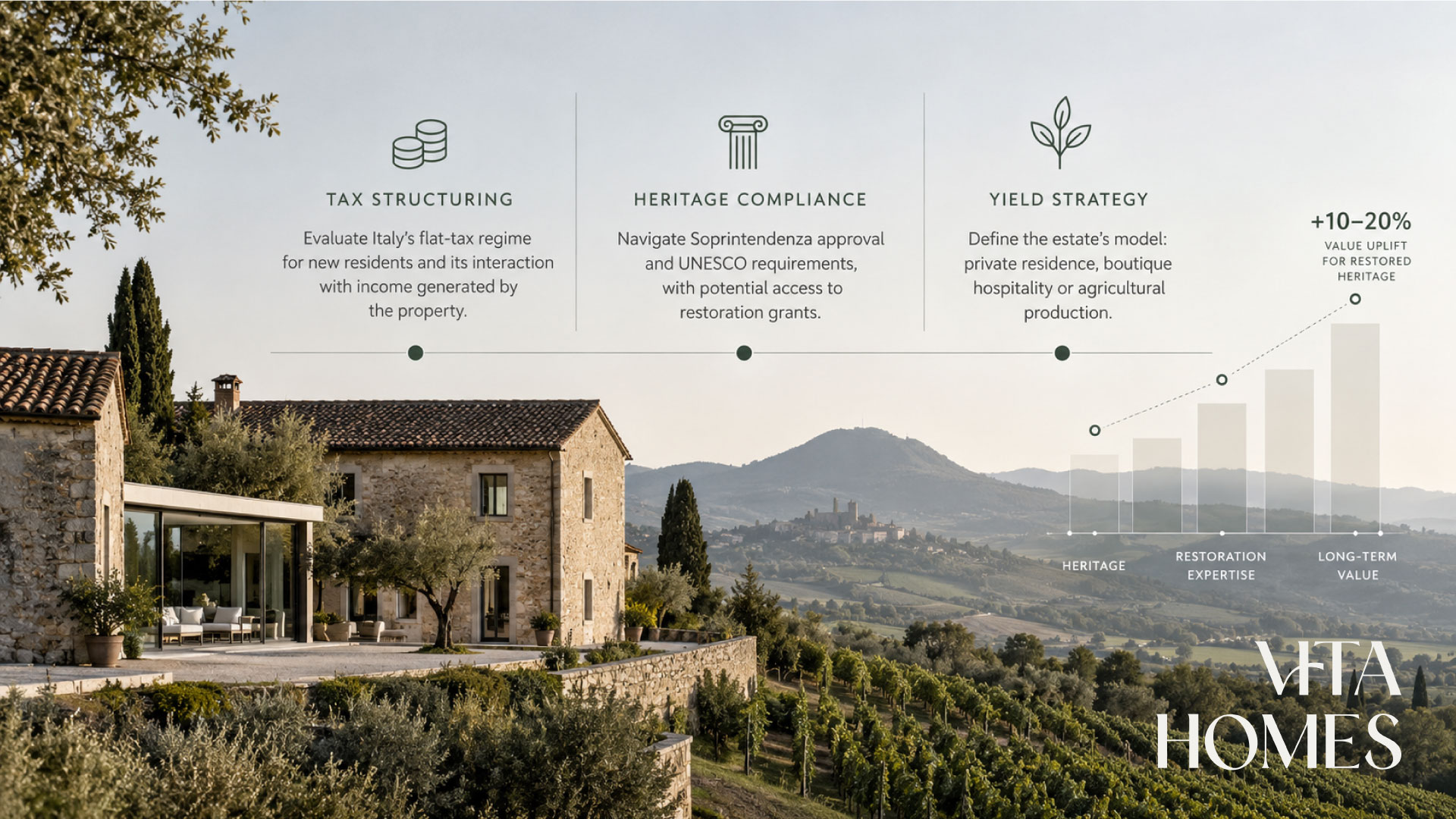
Heritage as a Working Asset: Restoring Historic Italian Estates in 2026
The most significant shift in Italian heritage property in 2026 is not about price — it is about purpose. Historic estates are no longer bought purely as private retreats. Increasingly, restoration is framed as an entrepreneurial strategy as much as an aesthetic one, and that changes everything about how these properties are chosen, restored and owned.

contact us
.avif)